
In this article
- 1. What Are Business Loans in Singapore?
- 2. Which are the Best Business / SME Loans in Singapore in 2026?
- 3. What Types of SME Loans Can You Choose From?
- 4. Who Can Apply for an SME Loan in Singapore?
- 5. What Documents Do You Need to Apply?
- 6. How Do You Choose the Right Business Loan?
- 7. How Do You Apply for a Business Loan in Singapore?
- 8. Why Might Your Business Loan Application Be Rejected?
- 9. Business Loan Singapore FAQs
Running a business often means spending money before the revenue catches up. You may need extra cash to pay suppliers, buy inventory, hire staff, purchase equipment or take on a larger project. A business loan can help cover that gap without using up your company’s cash reserves. In Singapore, SMEs can choose from regular bank loans, government-assisted financing and newer digital lending options.
There is no single “best” SME loan for every business. The right option depends on how much you need, what you need the money for, how quickly you need it and how comfortably your business can repay it.
What Are Business Loans in Singapore?
A business loan is financing taken by a company for business-related expenses rather than personal spending. Common uses include:
- Paying suppliers and operating expenses
- Managing temporary cash flow gaps
- Buying stock or inventory
- Hiring employees
- Renovating or expanding premises
- Purchasing machinery or equipment
- Funding business expansion
Some loans provide a lump sum that you repay in monthly instalments. Others work as revolving credit lines, allowing you to draw funds only when needed.
Singapore businesses can also access government-assisted financing under Enterprise Singapore’s Enterprise Financing Scheme (EFS). The government shares part of the lender’s risk, but the business remains responsible for repaying the full loan.
Which is the Best Business / SME Loan in Singapore in 2026?
Here are some of the main options worth comparing. Rates shown are advertised or indicative figures and your actual offer will depend on the lender’s assessment.
| Loan | Maximum Financing | Tenure | Advertised / Indicative Rate | Good Fit For |
| EFS SME Working Capital Loan | S$500,000 per borrower | Up to 5 years | Set by participating lender | Day-to-day working capital |
| DBS Business Loan | S$500,000 | Up to 5 years | From 7% p.a. | General business expenses and expansion |
| OCBC Business First Loan | S$100,000 | Up to 5 years | Around 8.75% p.a. indicative | Young businesses from 6 months old |
| OCBC Business Term Loan | S$700,000 | Up to 5 years | 7.75%–11% p.a. indicative | Larger expansion and operational needs |
| OCBC Revolving Term Loan | S$200,000 | 6 or 12 months per drawdown | 8.88% p.a. | Short-term or changing cash flow needs |
| GXS FlexiLoan Biz | S$150,000 credit limit | 2–36 months | From 4.99% p.a.; EIR from 9.32% p.a. | Businesses wanting flexible on-demand credit |
| EFS SME Fixed Assets Loan | Subject to S$50 million overall EFS borrower-group limit | Up to 15 years | Set by participating lender | Machinery, equipment and business premises |
Loans & Schemes
The governmental scheme – EFS’ SME Working Capital Loan currently allows eligible SMEs to borrow up to S$500,000 per borrower, with repayment of up to five years. From 1 September 2026 to 31 March 2027, Enterprise Singapore’s risk share for the scheme will increase to 70% for all enterprises. Borrowers still have to repay 100% of their loans.
DBS Business Loan offers up to S$500,000 over five years, with advertised rates starting from 7% p.a. DBS also allows businesses to apply digitally and may require fewer documents where information can be retrieved through ACRA or MyInfo Business.
OCBC Business First Loan is aimed at younger companies. Businesses can apply from six months of operation and borrow up to S$100,000 over five years. For more established companies, OCBC Business Term Loan provides up to S$700,000 without collateral, with repayment of up to five years. Its current calculator shows indicative rates between 7.75% and 11% p.a.
Businesses that do not want to borrow the entire amount upfront can consider a revolving loan. OCBC Revolving Term Loan provides a credit line of up to S$200,000, while GXS FlexiLoan Biz provides a standby credit line of up to S$150,000. Both let businesses borrow when funds are actually required rather than taking the whole facility at once.
For machinery, equipment, factories or other long-term assets, the EFS SME Fixed Assets Loan may be more suitable. It supports qualifying domestic and overseas fixed-asset purchases with repayment periods of up to 15 years.
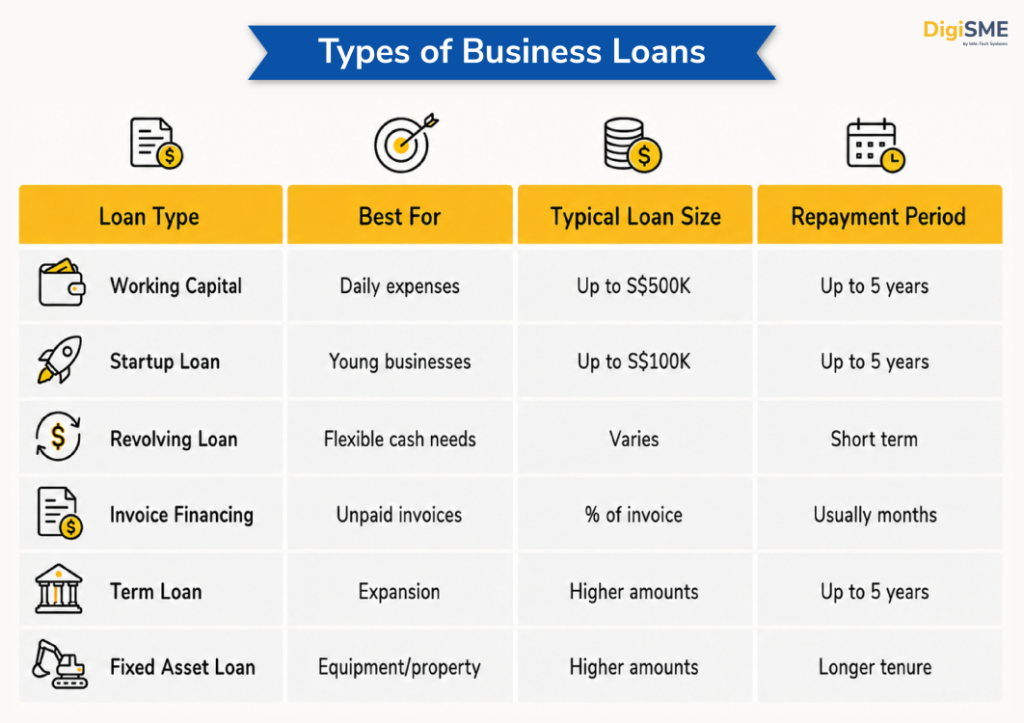
What Types of SME Loans Can You Choose From?
The type of financing matters just as much as the lender.
Working capital loans are useful for normal operating expenses such as payroll, inventory, rent and supplier payments. The EFS SME Working Capital Loan is one of the main government-assisted options available to Singapore SMEs.
Business term loans give you a lump sum that is repaid over a fixed period. They can work well when you already know how much funding you need for an expansion, renovation or major purchase.
Revolving business loans provide an approved credit limit that can be drawn when needed. They are useful when your funding requirement changes from month to month.
Invoice financing releases cash tied up in unpaid invoices. Instead of waiting 30, 60 or 90 days for customers to pay, a business can obtain financing against eligible receivables. OCBC, for example, currently offers short-term financing against up to 80% of invoices, with repayment periods of 30 to 120 days.
Fixed asset financing is intended for larger purchases such as machinery, equipment and commercial premises. It generally offers longer repayment periods because the assets are expected to be used for several years.
Who Can Apply for an SME Loan in Singapore?
Eligibility depends on the lender and loan. For the Enterprise Financing Scheme SME Working Capital Loan, the business must:
- Be registered and operating in Singapore
- Have at least 30% local equity held by Singapore Citizens or Permanent Residents
- Have group annual sales turnover not exceeding S$500 million
- Meet the SME definition of group revenue up to S$100 million or no more than 200 employees
Commercial lenders may have additional requirements. For example, OCBC’s Business First Loan accepts qualifying businesses from six months of operation, while its Business Term Loan generally requires the company to have been locally incorporated for at least two years. UOB states a minimum operating history of one year for its listed business loan options.
Approval is never automatic. The lender will normally look at your revenue, cash flow, existing debt, repayment history and the financial position of the business and its guarantors.
What Documents Do You Need to Apply?
Digital applications have reduced the amount of paperwork needed for some SME loans, particularly when business information can be retrieved through Singpass, MyInfo Business or ACRA.
Depending on the lender, you may still need:
- ACRA business information
- Recent company bank statements
- Latest profit and loss statement
- Balance sheet or financial statements
- Identification details for directors or guarantors
- Notice of Assessment for guarantors
- Details of existing loans or financial commitments
DBS states that businesses applying through ACRA or MyInfo Business may not need to manually provide most financial information, although additional documents such as financial statements or bank statements can still be requested.
Keep your records current before applying. Missing or inconsistent figures can slow down the assessment.
How Do You Choose the Right Business Loan in Singapore?
Start with the reason you are borrowing. If you need S$50,000 to buy inventory for the next three months, a five-year loan may be unnecessary. If you are buying machinery that will be used for eight years, a six-month revolving facility may create too much repayment pressure.
Compare more than the advertised interest rate. Look at things such as:
- Effective Interest Rate (EIR): This gives a better picture of borrowing cost after taking the repayment structure and applicable charges into account.
- Fees: Check facility, processing, annual and early repayment fees.
- Monthly repayment: Make sure repayments remain manageable even during quieter months.
- Loan tenure: Longer repayment reduces monthly payments but can increase total interest.
- Collateral and guarantees: An unsecured loan may still require directors or shareholders to give personal guarantees.
- Repayment flexibility: Check whether you can make early repayments without additional charges.
How Do You Apply for a Business Loan in Singapore?
The process is fairly straightforward. First, work out how much money your business actually needs and what it will be used for. Borrowing more simply because a larger amount is available increases your repayment burden.
Next, compare a few suitable lenders rather than applying everywhere at once. Check the interest or EIR, fees, repayment period, loan limit and eligibility rules.
Prepare your company information and financial documents, then submit the application directly to the lender. Government-assisted loans are also applied for through participating financial institutions rather than being automatically issued by Enterprise Singapore.
The lender will assess the company and, where applicable, its guarantors. If approved, you will receive an offer showing the loan amount, interest rate, fees and repayment terms. Read the offer carefully before accepting it. The final terms offered to your business may differ from rates advertised online.
Why Might Your Business Loan Application in Singapore Be Rejected?
A lender may decline an application even when the business meets its basic eligibility requirements. Common reasons include:
- The business has only been operating for a short time
- Revenue or cash flow is inconsistent
- The company already has substantial debt
- Monthly repayments appear difficult to manage
- Directors or guarantors have weak credit histories
- Financial records are incomplete
- The requested loan is too large compared with the business’s income
- The company does not meet the lender’s ownership or operating-history requirements
Applying for a smaller, more realistic amount can sometimes make more sense than stretching repayments simply to obtain the maximum available financing.
Keep your financial records application-ready. From accounting & bookkeeping and GST filing to corporate tax and audit support, we help SMEs keep their accounts organized. Get in touch with us to stay tax compliant.
Business Loan Singapore FAQs

Transforming thoughts and concepts into clear, compelling words is a powerful tool that connects people. While writing boosts my creativity, reading broadens my perspective and sharpens my understanding of language and narration.