
In this article
Dropshipping gives small businesses a way to sell online without filling a spare room or warehouse with stock. You list the products, while a supplier keeps them on hand and sends each order straight to the customer.
That can make it easier to try ecommerce or add new products without spending heavily upfront. The trade-off is that customers still deal with you when an order is late, damaged or simply not what they expected.
What is Dropshipping?
Dropshipping means you can sell products without keeping them in stock yourself. Instead, a third-party supplier stores the products and sends them out when someone places an order.
You choose what to sell, add the products to your online store and decide how much to charge. From there, the supplier takes care of storing, packing and shipping the order, as well as keeping track of stock. That leaves you to focus on the parts customers actually see, such as your store, pricing, marketing and customer service. You’ll also be the one handling questions, refunds or complaints if something goes wrong.
What you earn depends on what is left after the supplier’s price and your other costs are taken out of the selling price.
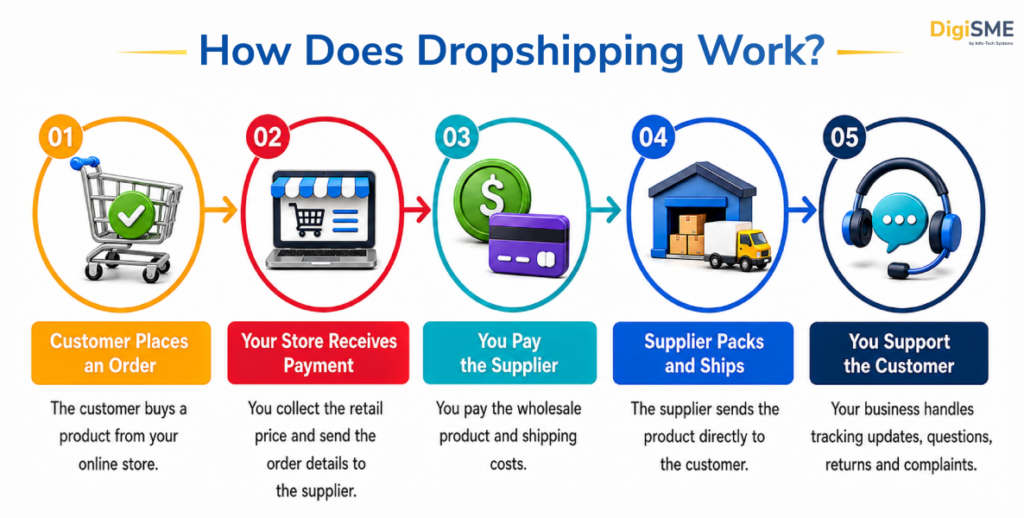
How Does Dropshipping Work?
A dropshipping sale is fairly straightforward. You add a supplier’s product to your store, a customer buys it, and you pass the order on to the supplier. The supplier then packs and ships the item, while you stay responsible for updates and customer support.
The numbers matter just as much as the process. If you sell an item for S$40 and pay the supplier S$22, that S$18 difference is not all profit. Shipping, advertising, payment fees, refunds and the cost of running your store still have to come out of it.
Some ecommerce platforms can handle tasks such as forwarding orders, syncing stock and updating shipment tracking automatically. That saves time, but it is still worth checking orders regularly so problems do not go unnoticed.
Why Do Small Businesses Use Dropshipping?
The main attraction is that you can start selling without investing heavily in inventory.
| Benefit | What It Means for a Small Business |
| Lower starting cost | You do not need to buy stock in bulk |
| No warehouse | The supplier stores the products |
| Easier product testing | Unsuccessful products can be removed quickly |
| Wider product choice | You are not limited by storage space |
| Flexible growth | Suppliers handle most fulfilment work |
Dropshipping can also help an existing business test new products before placing a wholesale order. If a product sells consistently, the business may later choose to stock it for better margins and faster delivery.
What Are the Risks of Dropshipping?
The main trade-off with dropshipping is control. You are relying on someone else to store, pack and ship the product, so problems such as late deliveries, damaged items or stock shortages can quickly become your problem too.
Margins can also be tight, especially when several stores are selling the same products. Branding may be limited, international returns can get messy, and you may have little say over the packaging customers receive. That is why the supplier matters so much. Before you list anything, order a sample and check the product quality, packaging and delivery time for yourself. Make sure you also know how the supplier handles returns, refunds and replacements.
And while dropshipping removes a lot of fulfilment work, it is not passive income. You still need to market the store, answer customers, keep an eye on suppliers and improve products or listings that are not performing well.
How Do You Start a Dropshipping Business?
A good place to start is with a small product range and a clear idea of who you want to sell to. A focused store is usually easier to market than one filled with unrelated products. For example, desk accessories for home workers gives you a much clearer audience than a general store selling a bit of everything.
From there, look at what people are actually buying. Search trends, competitor stores, marketplace reviews and social media can all give you a sense of demand. Try not to rely too heavily on products that are popular for only a few weeks.
Your supplier deserves just as much attention as the product itself. Compare product quality, delivery times, customer support, stock updates, return terms and tracking options. If branding matters to you, check whether they offer neutral or branded packaging. Always order a sample before putting a product up for sale.
Then work out what each sale will really cost you. The supplier price is only part of it. Shipping, platform fees, advertising, payment charges and returns can quickly eat into what looks like a healthy markup. Once the numbers make sense, build a simple store with clear descriptions, realistic images, secure payment options and easy navigation. Avoid copying supplier descriptions without checking that they are accurate. It is also worth sorting out your delivery, return, refund and cancellation policies before launch. Make sure you understand any business, tax or product rules that apply where you sell.
Start small, spend cautiously on marketing and see how customers respond. Track what sells, what each order costs you and where complaints tend to come from. Scale only when the results are working in your favour.
Is Dropshipping Right for Your Small Business?
Dropshipping can be a good fit if you want to start selling with less upfront investment, test products before committing to stock or add new items without taking on warehouse space. It is less appealing when your business depends on fast delivery, custom packaging or tight quality control. The same goes for products that need in-person collection or leave very little room for profit.
For many small businesses, dropshipping makes the most sense as a way to test demand without tying up too much money in inventory. The model is simple, but the results still come down to reliable suppliers, sensible pricing and how well you look after customers.
Running a dropshipping business means tracking supplier payments, customer revenue, shipping costs, and marketing expenses across multiple platforms. Seeing your finances clearly helps you understand which products generate profit and where to focus your efforts. For payroll outsourcing and to automate bookkeeping services singapore, choose DigiSME Singapore – maintain accurate accounts and be tax-ready. Contact us to talk to an expert regarding corporate tax filing or audit support.
Dropshipping FAQs

Transforming thoughts and concepts into clear, compelling words is a powerful tool that connects people. While writing boosts my creativity, reading broadens my perspective and sharpens my understanding of language and narration.