
In this article
When you register a business in Singapore, one of the first details you receive is a Unique Entity Number, commonly called a UEN.
You will need this number regularly. It appears in government filings, tax records, invoices, bank applications and many other business documents. Whether you run a small shop, a growing company or a professional services firm, it is important to know where to find your Unique Entity Number and when to use it.
What is a UEN?
A Unique Entity Number is the official identification number given to a registered business or organisation in Singapore.
It works like an identification number for your business. Government agencies use it to recognise your entity and match your submissions, payments and records correctly.
The UEN system also means businesses do not need a different identification number for every government department.
Who needs a UEN?
Most registered entities in Singapore receive a Unique Entity Number. These include:
- Private limited companies
- Sole proprietorships
- Partnerships
- Limited liability partnerships
- Foreign companies registered in Singapore
- Charities and non-profit organisations
- Registered societies
- Trade unions
- Educational and healthcare institutions
- Government and public sector entities
A freelancer who has not registered a business may not have a Unique Entity Number. ACRA may issue it once the freelancer registers a sole proprietorship, partnership or company.
Individuals use personal identification numbers such as an NRIC or FIN rather than a Unique Entity Number.
Who issues the UEN?
Most Singapore businesses receive their Unique Entity Number from the Accounting and Corporate Regulatory Authority, or ACRA.
The number is normally issued automatically when the business registration or company incorporation is approved through Bizfile. There is usually no separate application for Unique Entity Number.
Other government agencies register some organisations and issue their Unique Entity Numbers based on the entity type.
Examples include:
- Registry of Societies for registered societies
- Commissioner of Charities for certain charities
- Ministry of Education for educational institutions
- Ministry of Health for healthcare organisations
- Singapore Land Authority for management corporations
What is a UEN used for?
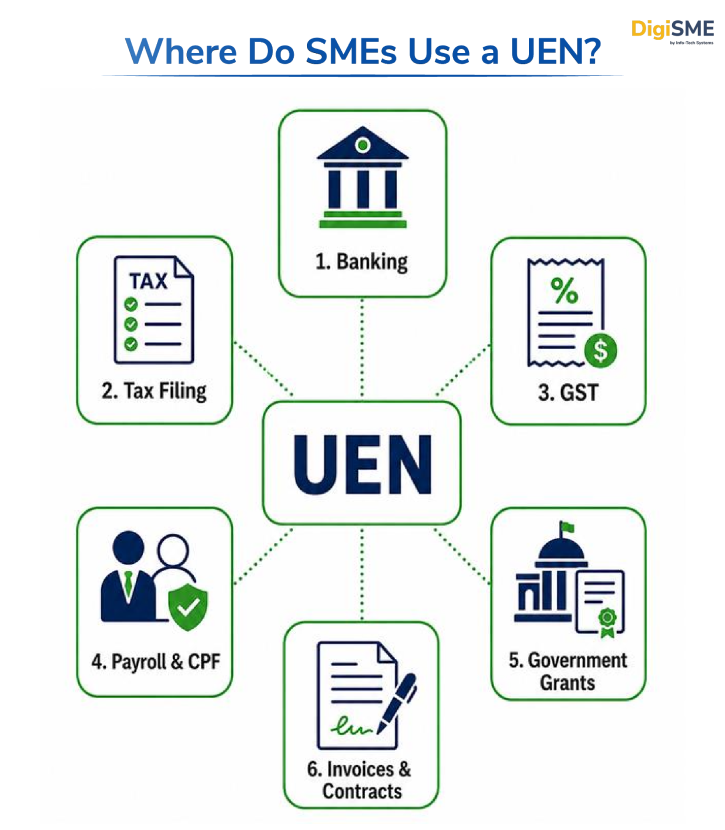
You will need your Unique Entity Number for many everyday business activities. Common uses include:
- Opening a corporate bank account
- Registering for Corppass
- Filing corporate income tax with IRAS
- Registering for GST filing
- Submitting GST returns
- Making CPF-related submissions
- Applying for licences and permits
- Applying for government grants
- Registering for PayNow Corporate
- Communicating with government agencies
- Issuing business invoices and official documents
Banks, customers, suppliers and auditors may also use the Unique Entity Number to confirm the identity of your business.
How do you get a UEN?
Once your business or organisation is successfully registered, you will receive a Unique Entity Number .
For most SMEs, the process is straightforward:
- Choose a business structure, such as a sole proprietorship or private limited company.
- Register the entity through ACRA’s Bizfile portal.
- Submit the required information about the business, owners, shareholders or directors.
- Receive the Unique Entity Number after the registration is approved.
The Unique Entity Number will appear in the registration confirmation and the entity’s business profile.
Foreign companies establishing a branch or other registered presence in Singapore will receive a Unique Entity Number through the relevant registration process.
What does a UEN look like?
A Unique Entity Number contains letters and numbers. Its format depends on the entity type and when it was registered.
| Entity type | Typical format | Format example |
| Businesses registered with ACRA | nnnnnnnnX | 53212345A |
| Local companies | yyyynnnnnX | 202312345A |
| LLPs and certain other entities | TyyPQnnnnX | T23LL1234A |
In these formats:
- yyyy or yy generally represents the registration year.
- PQ represents the entity-type code, such as LL for a limited liability partnership.
- n represents a number.
- The system uses X as a check alphabet to validate the number.
The format can differ for societies, charities, trade unions and entities registered by agencies other than ACRA.
How do you find a UEN?
You can usually find your business Unique Entity Number on:
- Your ACRA business profile
- Registration confirmation documents
- IRAS correspondence
- Corporate tax records
- GST registration documents
- Bank account records
- Company invoices and letterheads
You can also search for a registered entity through the Unique Entity Number or Bizfile entity search. Enter the business name to view information such as its Unique Entity Number, entity type and current registration status.
Checking the entity status is useful before signing a contract, appointing a supplier or making a large business payment. The Unique Entity Number identifies the entity, whereas the search result helps confirm whether it is currently registered and active.
Can you change a UEN?
A Unique Entity Number is generally permanent.
Changing the company name, registered address or business activity does not usually change it. The business must update its particulars with the relevant registration agency, but it continues using the same identification number.
A new Unique Entity Number may be issued when a completely new entity is registered or when a business changes to a different legal structure through a new registration.
For example, converting from a sole proprietorship into a private limited company may involve registering a separate legal entity with a new Unique Entity Number.
Can you choose a special UEN?
ACRA offers a Special Unique Entity Number option for businesses that prefer a memorable number pattern.
These numbers may contain repeated digits or combinations that are considered easy to remember. Only part of the number can be selected. Details such as the registration-year prefix, entity code and final check alphabet are system-generated.
Special Unique Entity Numbers carry an additional fee and are subject to availability. The reference sources describe two selection tiers, commonly priced at S$1,000 and S$3,000 depending on the number pattern. Businesses should confirm the current options and fees during registration.
What Should SMEs Do After Receiving UEN?
Receiving a Unique Entity Number is only one part of setting up a business. New SMEs should also organise their accounting, payroll and tax records from the beginning.
This includes:
- Recording business income and expenses
- Maintaining invoices and supporting documents
- Opening a separate corporate bank account
- Checking GST compliance requirements
- Preparing payroll and CPF submissions (Payroll outsourcing is an option)
- Monitoring corporate tax filing deadlines
- Keeping records ready for audits or reviews
Reliable accounting and bookkeeping services can help keep transactions, bank reconciliations and monthly accounts accurate.
While Unique Entity Number gives your business its official identity, proper financial records and compliance processes help keep that identity in good standing as the company grows.
UEN Frequently Asked Questions

Transforming thoughts and concepts into clear, compelling words is a powerful tool that connects people. While writing boosts my creativity, reading broadens my perspective and sharpens my understanding of language and narration.