

In this article
- 1. Why Register a Company in Singapore?
- 2. What Do You Need Before You Register?
- 3. How Do You Choose Your Company Name?
- 4. How Do You Actually Register The Company?
- 5. Can Foreigners Register A Company in Singapore?
- 6. Do You Have to Move to Singapore?
- 7. What Happens After Registration?
- 8. How Much Does Company Registration Cost?
- 9. How Long Does Registration Usually Take?
- 10. Company Registration Singapore FAQs
Starting a company in Singapore is fairly straightforward, which is one reason the country attracts both local and overseas founders. The registration itself is handled by the Accounting and Corporate Regulatory Authority (ACRA) through Bizfile, and a simple application can move quite quickly.
That said, there are a few things to sort out before you get to the registration page. You need to know what type of business you are setting up, who the directors and shareholders will be, where the company will be registered and what documents you need.
Here is what the process looks like in 2026.
Why Register a Company in Singapore?
Singapore has a reputation for being business-friendly, and there are practical reasons for that. The corporate income tax rate is 17%, the registration system is mostly online, and foreign founders can generally own 100% of a Singapore company. You don’t need to give shares to a Singaporean partner just because you’re a foreign founder. You do, however, need at least one director who meets Singapore’s local residency requirements.
For founders planning to build a larger business, a registered company also makes sense from a liability point of view. A private limited company has its own legal identity, separate from its shareholders. This is one of the reasons the Pte Ltd structure is so common among startups and growing businesses.
What Do You Need Before You Register?
For a private limited company, you need at least one shareholder and one director. At least one director has to meet Singapore’s local residency rules. You don’t need a large amount of money to get started. A private limited company can be incorporated with just S$1 in issued share capital.
You’ll also need a Singapore registered office address. On top of that, prepare your shareholder and director details, company constitution, business activities and the appropriate Singapore Standard Industrial Classification (SSIC) codes.
A company secretary is required as well. You don’t necessarily have to have every post-incorporation task completed before submitting the application, but you should already understand who will handle these responsibilities. If you’re a foreign founder and can’t submit the registration yourself, you’ll generally need to use a registered filing agent or corporate service provider.
How Do You Choose Your Company Name?
You’ll need an approved business name before incorporating the company.
The name shouldn’t be identical or too similar to an existing business name, and ACRA can reject names that are offensive or otherwise unsuitable. Most uncomplicated applications can be dealt with quickly. A name that needs to be reviewed by another government agency may take longer.
Once your name is approved, it’s normally reserved for 120 days. That gives you time to finish preparing the company and submit the incorporation application.
Read also: What is UEN in Singapore? A Complete Guide for SMEs
How Do You Actually Register The Company?
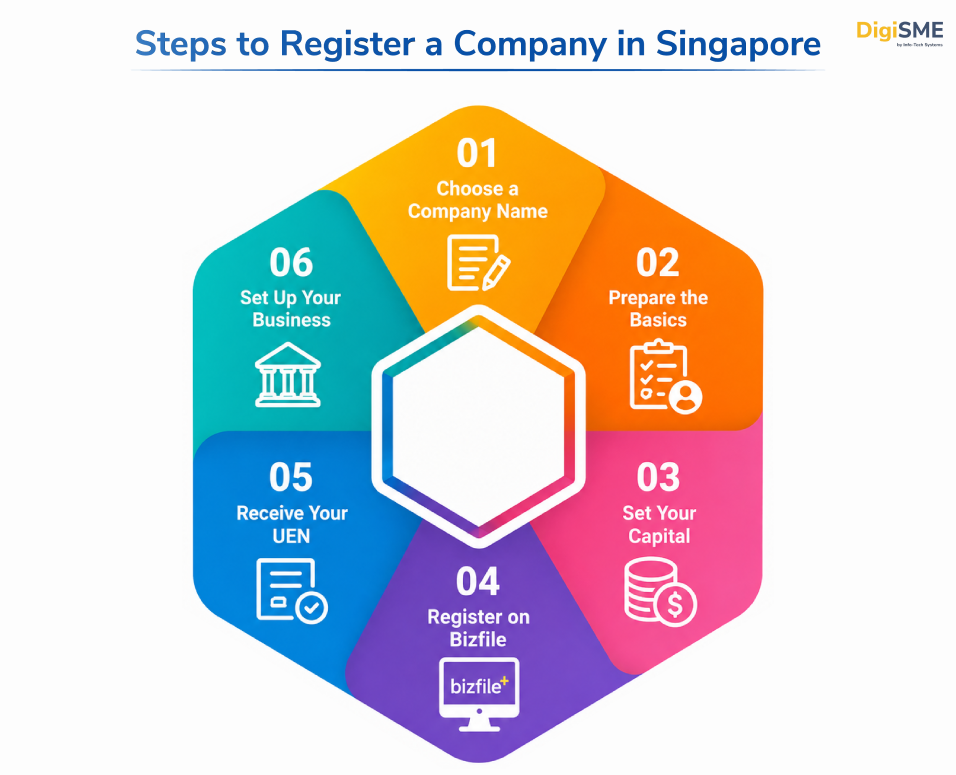
The incorporation application is submitted through ACRA’s Bizfile portal. You’ll enter the company’s basic information, including its address and business activities, followed by details of the directors, shareholders, share capital and company officers.
For a standard local company, the registration fee is S$300, in addition to the separate company-name application fee. If everything is in order, registration can be surprisingly quick. More complicated applications may take longer, particularly when another government agency needs to review them.
Once the company is successfully incorporated, it receives a Unique Entity Number (UEN). You’ll use this number regularly when dealing with government agencies and other business matters.
Read also: Best SME Government Grants in Singapore 2026
Can Foreigners Register A Company in Singapore?
Yes, and you can generally own the entire company. This is sometimes misunderstood because Singapore also requires a locally resident director. The director requirement doesn’t mean you need a Singaporean shareholder or business partner.
So, for example, an overseas founder could own 100% of the shares while appointing a director who satisfies the local residency requirement. If you’re handling the setup from outside Singapore, you will usually work with a registered filing agent to complete the incorporation.
Do You Have to Move to Singapore?
No, owning a Singapore company doesn’t mean you have to relocate there. You can remain overseas while owning the company, provided the business continues to meet its Singapore requirements, including having a registered office and the required locally resident director.
Actually moving to Singapore to work in the business is a different issue. In that situation, you would also need to look at the appropriate immigration or work-pass requirements.
What Happens After Registration?
Getting the UEN doesn’t mean you’re completely finished. You’ll probably want to open a corporate bank account fairly soon. Keeping business money separate from personal funds makes everyday accounting & bookkeeping much easier and gives you cleaner records when tax filing comes around. For professional audit support, get in touch with us – speak to an expert today!
It’s also a good idea to get reliable accounting software running from day one rather than trying to rebuild months of transactions later.
Depending on what your company does, you may need licences or permits before you start trading. GST is another area to keep an eye on as the business grows, particularly if your taxable turnover approaches the compulsory registration threshold.
There will also be ongoing ACRA and IRAS filing requirements, so incorporation should be treated as the beginning of the company’s compliance work rather than the end of it.
How Much Does Company Registration Cost?
The ACRA registration fee for a standard local company is S$300, plus the separate fee for the company-name application. But that’s not necessarily your total setup cost.
If you’re a foreign founder, for instance, you may need to pay a corporate service provider. There can also be costs for a registered address, company secretary, accounting, tax filing and, where required, arrangements to meet the resident-director requirement.
It’s better to budget for the first year of running the company rather than looking only at the incorporation fee.
How Long Does Registration Usually Take?
A straightforward application can be approved quickly once it has been submitted and paid for. The part that tends to slow founders down is everything that comes before it.
A name might need additional approval. A foreign founder may still be arranging a resident director. Shareholder documents could be incomplete. The business might also need to be referred to another government agency.
So while registering a simple company can be fast, it’s sensible not to plan your launch around the assumption that approval will always be immediate.
Company Registration Singapore FAQs

Transforming thoughts and concepts into clear, compelling words is a powerful tool that connects people. While writing boosts my creativity, reading broadens my perspective and sharpens my understanding of language and narration.